
A Reference Model for What It Takes for a Language to Live End-to-End Online
The Internet Isn’t a List of Features. It’s an Experience
Domain names, websites, and apps all matter but users don’t experience the internet in pieces. They experience it as one continuous journey: expressing ideas, making decisions, navigating systems, and managing their lives online.
True digital inclusion means language is present at every step. When a language is readable but not writable, or available for browsing but missing during payments or safety warnings, users are forced to abandon their language midstream.
The Language Infrastructure Framework maps where language must exist end-to-end so everyone can participate online in their own language.
The Layers of the Language Infrastructure Framework
Our Core Benchmark: End-to-End Presence
A language is only truly present online if someone can complete everyday digital tasks entirely in that language without being forced into an unwanted fallback.
To achieve this, a language must progress through three interconnected phases:
- Foundations: Systems can reliably process, render, and recognize the language.
- Interaction: Tools, interfaces, and inputs work seamlessly in-language.
- Ecosystem: Information, services, algorithms, and safety protections exist for everyone.
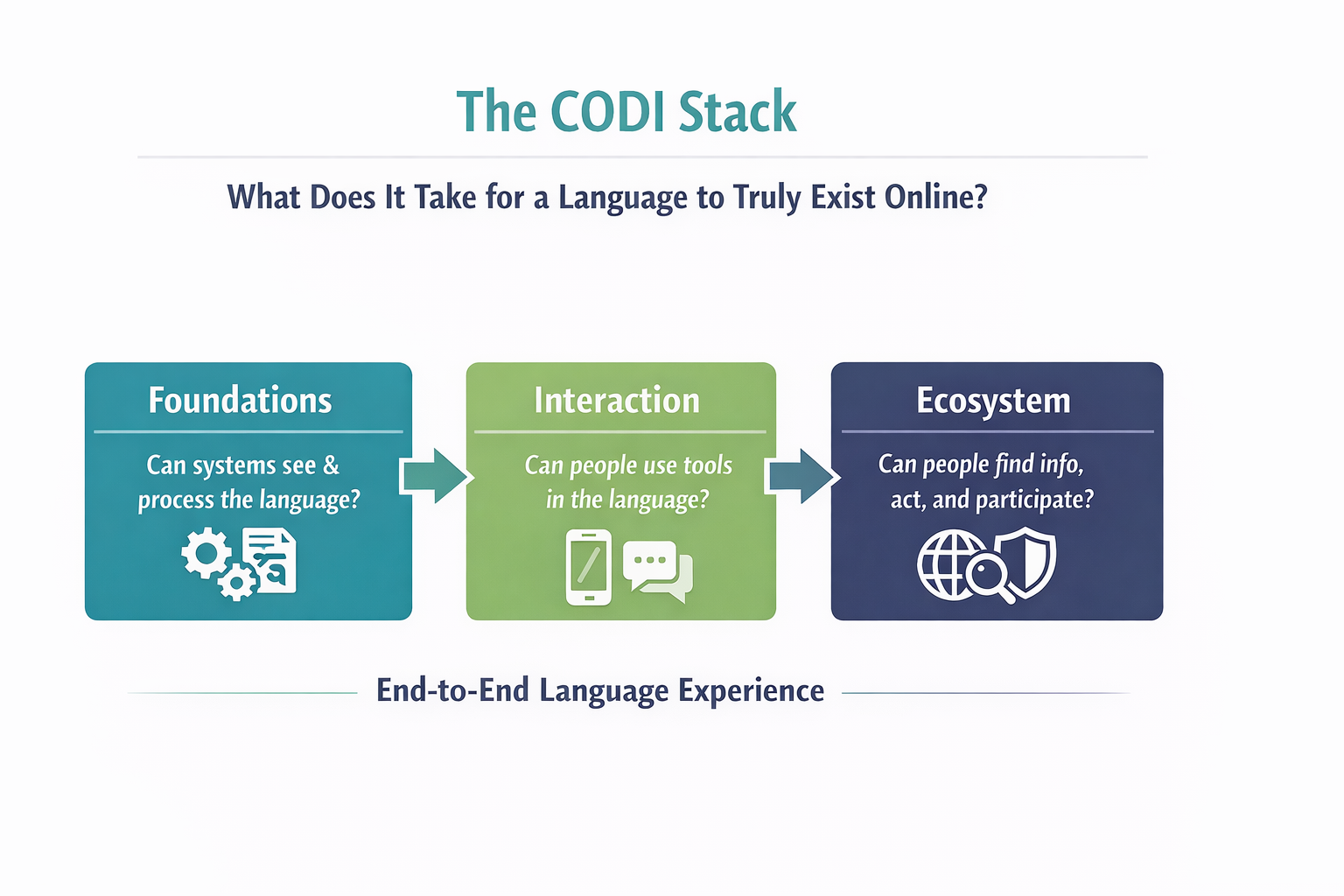
A Diagnostic Tool, Not a Scorecard
By examining the user journey layer by layer, we can pinpoint exactly where a language drops out and where exclusion builds up. The goal isn't to rank or compare languages, it's to establish a shared vocabulary so our global community can target structural barriers and build lasting solutions.
Technical Foundations
User Interaction with Systems
Participation in the Broader Internet